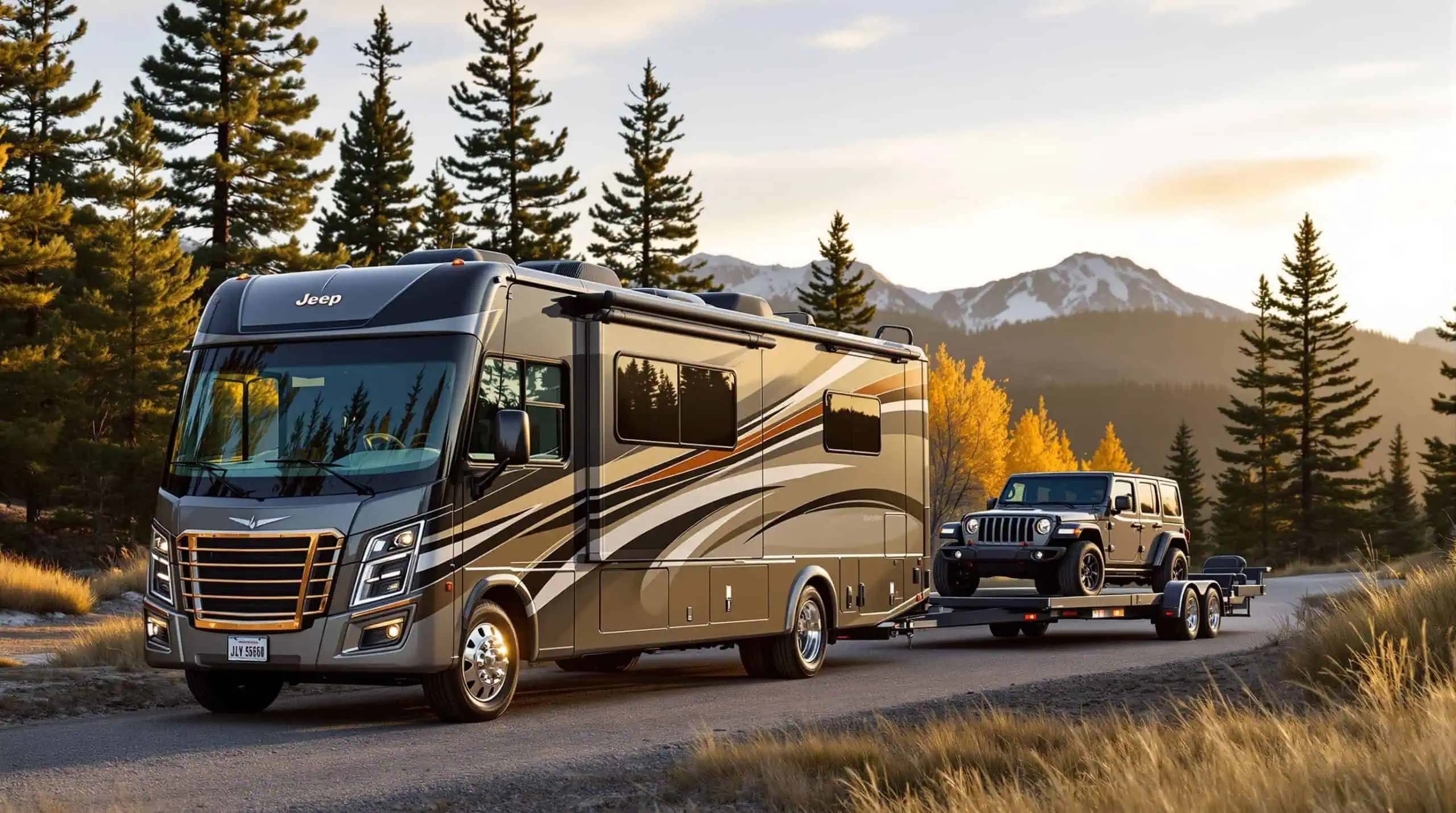
You pull into a campsite outside Salida after a long haul over Monarch Pass, and your Class A is parked, leveled, and quiet within minutes. No unhitching a trailer, no backing a dolly off the ramps. You just unlock the tow bar, hop in your Jeep or truck, and you've got wheels for grocery runs and trailhead access all weekend. That's the appeal of flat towing, and it's why so many Colorado Springs RVers ask about it, but the setup behind that convenience matters a lot more once mountain grades enter the picture.
Key Takeaways
- Not every vehicle qualifies for flat towing: manufacturers publish specific towing guidance, and ignoring it can damage a transmission or drivetrain.
- Supplemental braking isn't optional in Colorado: steep grades on passes like Wolf Creek or Monarch demand a braking system that reacts with the RV, not after it.
- Baseplates are vehicle-specific: a properly fitted baseplate distributes load correctly and keeps your tow bar aligned under real-world stress.
- Mountain driving changes the math: altitude, grade, and combined weight all affect how a flat tow setup performs compared to flat, low-elevation towing.
- Professional installation protects your warranty and your safety: torque specs, wiring integration, and braking calibration are not places to guess.
- Routine inspection extends the life of your setup: cables, safety chains, and electrical connections take a beating on Colorado's varied road surfaces.
1. What Flat Towing Is and How It Differs From Dolly or Trailer Towing
Flat towing, sometimes called "dinghy towing" or towing "four down," means all four wheels of the towed vehicle stay on the ground while it follows behind your RV. A tow bar connects the vehicle's baseplate to a hitch receiver on the back of the motorhome, and the vehicle rolls along under its own suspension. This is different from a tow dolly, which lifts the front two wheels off the pavement, and different again from a full trailer, which lifts the entire vehicle. Each method has tradeoffs in cost, storage, and vehicle compatibility, but flat towing is the most popular choice among Colorado Springs RVers because of how quickly you can hitch and unhitch at camp.
The catch is that flat towing only works for vehicles engineered to handle it. Dollies and trailers are more forgiving because the towed vehicle's drivetrain isn't spinning while it moves. With flat towing, wheels, axles, and in some cases the transmission are all turning the entire time you're on the road, which is why manufacturer specifications matter so much before you commit to a setup.
Flat Tow vs. Dolly vs. Trailer
A dolly cradles the front wheels and works for many front-wheel-drive cars that aren't rated for flat towing, but it adds a piece of equipment you need to store at camp and maneuver into position. A trailer lifts the vehicle entirely, which protects the drivetrain completely but requires the most storage space and the highest tow vehicle capacity. Flat towing needs the least storage, the fastest hookup, and no ramps, but it demands a vehicle that's either manual-transmission, four-wheel-drive with a neutral transfer case, or otherwise specifically rated by its manufacturer for towing this way.
Why Colorado RVers Favor Flat Towing
Front Range campers who boondock or explore national forest roads often want a capable 4x4 waiting at camp, not a car stuck on a dolly. Flat towing lets you disconnect in minutes and head straight up a forest service road without unloading anything. For military families stationed at Fort Carson or Peterson Space Force Base who camp on weekends, that speed matters when you're trying to maximize a short window before heading back.
Common Vehicles Suited to Flat Towing
Jeep Wranglers and Gladiators are the classic choice because of their manual transfer cases, but several trucks and SUVs from Ford, Ram, and Chevrolet also carry factory flat tow ratings in certain trim and drivetrain configurations. The list changes by model year, so checking your specific vehicle's owner's manual or contacting the manufacturer is the only reliable way to confirm.
2. Key Components: Baseplate, Tow Bar, and Supplemental Braking
A flat tow system is really three separate pieces working together, and skipping or mismatching any one of them creates a weak link. The baseplate bolts to your towed vehicle's frame and gives the tow bar somewhere secure to attach. The tow bar itself connects that baseplate to the RV's rear hitch receiver, and it needs to flex enough to handle turns and uneven pavement while staying rigid enough to track straight on the highway. Supplemental braking activates the towed vehicle's own brakes in sync with the motorhome's brakes, which is the piece most new flat towers underestimate.
Without supplemental braking, your motorhome's brakes are doing all the stopping work for the combined weight of the coach and the towed vehicle. On flat interstate driving that might feel manageable. On a descent off Wolf Creek Pass or coming down from Pikes Peak's lower approaches, that's a very different story, and it's also a legal requirement in Colorado and most states once combined towed weight crosses a certain threshold.
Baseplate Fitment and Load Rating
Baseplates are engineered per vehicle model because they need to bolt to specific frame points without interfering with airbags, sensors, or tow hooks. A baseplate rated below your vehicle's actual towing weight will flex or fail under sustained highway stress, so verifying the load rating against your vehicle's curb weight is a step worth confirming before installation, not after.
Tow Bar Types and Mounting Style
Tow bars generally mount either to the RV (motorhome-mounted) or to the towed vehicle (car-mounted), and each style has a slightly different hookup routine. Motorhome-mounted bars tend to be easier for solo RVers to manage because they stay with the coach, while car-mounted bars fold down onto the vehicle and connect to a fixed arm on the RV. Either style needs to match your hitch receiver's class and weight rating.
Supplemental Braking Systems Explained
Supplemental brake systems range from portable units you move between vehicles to permanently installed systems wired into the towed vehicle's brake lines. Manufacturers like Roadmaster publish detailed specifications on how their systems detect motorhome braking and proportion braking force to the towed vehicle, which is worth reviewing so you understand what you're relying on at 65 miles per hour on I-25.
3. Is Your Vehicle Flat Towable? What to Check First
Before any hardware gets ordered, the vehicle itself has to clear a basic qualification check, and this is the step most likely to get skipped by a new RVer excited to hit the road. Most manufacturers publish a flat tow towing guide, either in the owner's manual or on their website, that spells out exactly which trims, model years, and drivetrain configurations are approved for towing four down. Vehicles without a factory flat tow rating can sometimes be towed anyway with aftermarket lubrication pumps or driveshaft disconnects, but that adds cost, complexity, and risk that a rated vehicle simply doesn't carry.
Automatic transmissions are the most common disqualifier. Many automatics rely on the engine running to circulate transmission fluid, and towing one with the engine off can cause internal damage within a short distance. Some modern automatics and continuously variable transmissions are specifically engineered to tolerate flat towing, but that has to be confirmed against factory documentation rather than assumed.
Reading the Manufacturer's Towing Guide
Every major manufacturer either publishes a standalone towing guide or includes flat tow instructions in the owner's manual, and these documents specify the exact steps required, like shifting into neutral, removing a specific fuse, or engaging a tow/haul mode. Following that sequence precisely every time you hitch up is what protects your drivetrain over years of use.
Aftermarket Solutions for Non-Rated Vehicles
If your vehicle isn't factory-rated but you still want to flat tow it, aftermarket options exist, such as auxiliary transmission fluid pumps that keep fluid circulating without the engine running. These solutions work, but they add moving parts and cost, and they should only be installed by someone familiar with your specific drivetrain.
Signs Your Setup Needs a Second Opinion
If you're not fully certain your vehicle qualifies, or if you've inherited a tow bar setup from a previous RV owner, it's worth having a technician verify vehicle compatibility and inspect the existing hardware before your next trip. A mismatched or improperly rated setup can look fine sitting in a driveway and still fail under real driving stress.
4. Weight and Chassis Considerations for Mountain Driving
Generic towing guides written for flat, low-elevation driving miss the factors that matter most to Colorado RVers. Combined weight, the total of your motorhome plus your towed vehicle plus cargo, has to stay within your RV's manufacturer-rated towing capacity, and that capacity doesn't stretch for mountain terrain. If anything, mountain driving asks more of your setup, not less, because sustained grades put extended load on brakes, transmissions, and hitch hardware in ways flat highway miles never do.
Altitude itself changes vehicle performance too. Engines lose some power output as elevation increases, which means your motorhome may already be working harder to maintain speed on a climb before you even factor in the weight of a towed vehicle. Combine that with a long descent, where your brakes are managing speed for both vehicles over several continuous miles, and you can see why supplemental braking and properly rated components aren't optional extras for Colorado towing. They're the baseline.
Combined Weight and Your RV's Rated Capacity
Your RV's manufacturer specifications include a maximum towing capacity that accounts for the hitch, chassis, and braking system as a unit. Adding a towed vehicle that pushes you near or over that limit strains components that were never designed for the extra stress, and it can affect handling on curves and during braking regardless of how well the tow bar itself is installed.
Grade and Braking Load on Passes Like Monarch and Wolf Creek
Long, sustained descents ask your combined braking system to dissipate heat continuously rather than in short bursts. A properly calibrated supplemental brake system shares that load with the towed vehicle's own brakes, which reduces strain on the motorhome's brakes and helps prevent brake fade on a mountain descent.
Elevation's Effect on Tow Vehicle Performance
Engines and transmissions both run differently at altitude, and towing adds a variable that engine tuning wasn't necessarily built around at 9,000 feet. Understanding this is less about a specific fix and more about respecting the margin, driving at moderate speeds on grades, using engine braking where appropriate, and not assuming flatland towing habits translate directly to mountain passes.
5. Why Professional Installation Matters for Safety
Here's a comparison of what changes when a flat tow system goes in correctly versus when shortcuts get taken, whether that's a DIY install or a rushed job elsewhere.
| Factor | Professional Installation | DIY or Rushed Install |
|---|---|---|
| Baseplate fitment | Matched to exact vehicle year and trim, properly torqued | Generic fit or incorrect torque, risk of frame stress |
| Braking calibration | System tested and adjusted to proportion correctly | Braking lag or over-application undetected until an emergency stop |
| Wiring integration | Lighting and brake signals verified against DOT requirements | Miswired brake lights or turn signals, a legal and safety issue |
| Weight verification | Confirmed against RV and towed vehicle rated capacities | Assumed compatible without checking published specs |
| Long-term reliability | Installed with manufacturer-specified hardware and inspected | Mismatched parts that wear unevenly or fail early |
Getting a flat tow system installed by someone who does this work regularly isn't about distrust in your own mechanical skills. It's about the fact that a baseplate bolted slightly off-spec, or a supplemental brake system that isn't calibrated correctly, might not show a problem for hundreds of miles of flat highway driving and then fail exactly when you need it most, on a steep grade with traffic behind you. That's not a risk worth taking to save an afternoon.
Certified installation also protects the manufacturer's warranty on your tow bar and braking components. Most tow bar and braking system manufacturers, including Roadmaster and similar brands, specify torque values, wiring routes, and testing procedures that a certified installer follows as a matter of course. Skip those steps and you may void coverage on hardware that's expensive to replace if it fails.
What a Proper Installation Includes
A complete flat tow installation covers baseplate mounting at the correct torque, wiring integration for brake lights and turn signals, supplemental brake system calibration, and a full function test before the vehicle leaves the shop. Each of those steps has a right way to do it, and each one matters just as much as the others.
The Cost of Getting It Wrong
An improperly installed baseplate can stress a vehicle's frame over time, leading to cracking or misalignment that's expensive to repair later. A miscalibrated braking system might pass a driveway test but behave unpredictably at highway speed, which is a safety risk for you and everyone else on the road.
Fixing What Others Said Couldn't Be Fixed
Some RV owners come to a shop after a big dealership told them their vehicle couldn't be flat towed, or that a part wasn't available. Often a careful review of manufacturer specifications and an inventory of the right certified components turns up a solution that a rushed consultation missed the first time.
6. Maintaining Your Flat Tow Setup for Long Colorado Road Trips
A flat tow system isn't a set-it-and-forget-it upgrade. It's hardware that lives outdoors, gets exposed to road salt in winter, gravel dust on forest service roads, and UV exposure that Colorado's high altitude sun delivers in spades. Regular inspection keeps small wear items from becoming trip-ending failures somewhere between Colorado Springs and wherever your next campsite happens to be.
Before every trip, a quick check of the tow bar's pivot points, the safety cable connections, and the electrical wiring harness takes just a few minutes and catches most developing problems early. Over a full camping season, that habit adds up to real reliability, especially if you're the kind of RVer putting real miles on mountain roads throughout the summer and fall.
Pre-Trip Inspection Checklist
Check the baseplate bolts for tightness, inspect the tow bar arms for smooth extension and locking, confirm safety cables are rated and not frayed, and test all lighting connections before you leave the driveway. A five-minute check now is far better than discovering a loose connection on I-25 with the family in the coach behind you.
Seasonal Wear Points Specific to Colorado
Hail season brings sudden storms that can pit exposed hardware, while winter road treatments introduce salt and grit that accelerate corrosion on tow bar arms and electrical connectors. Rinsing components after storms and after winter driving, and applying manufacturer-recommended lubrication to pivot points, extends the life of the whole system.
When to Bring the Setup in for Service
If you notice resistance when extending or locking the tow bar, corrosion on wiring connectors, or any change in how the supplemental brake system responds, that's the signal to get it inspected rather than wait for a failure. Catching wear early is almost always simpler and less disruptive than dealing with a breakdown mid-trip.
FAQs
Can any vehicle be flat towed behind an RV?
No. Flat towing requires a vehicle either rated by the manufacturer for towing four down or fitted with aftermarket solutions like a transmission fluid pump. Always confirm compatibility against your vehicle's owner's manual before assuming it can be flat towed.
Do I legally need supplemental brakes to flat tow in Colorado?
Colorado, like most states, requires supplemental braking once the towed vehicle's weight crosses a specific threshold, and it's a strong safety practice even below that threshold. Mountain grades make reliable braking especially important regardless of the legal minimum.
How much does elevation affect towing performance in Colorado?
Elevation reduces engine power output somewhat, which means your motorhome works harder on climbs even before adding a towed vehicle's weight. This makes properly rated components and moderate driving speeds on grades more important than they would be at lower elevations.
Can a flat tow baseplate be transferred to a different vehicle?
No, baseplates are engineered for specific vehicle makes, models, and often specific trim years, so they don't transfer between different vehicles. A new vehicle requires its own properly matched baseplate.
How often should a flat tow system be inspected?
A quick check before every trip is recommended, along with a more thorough inspection at least once per camping season or after any hail storm or long winter drive. Catching wear on cables, wiring, or the tow bar's mechanism early prevents bigger problems on the road.
Conclusion
Flat towing gives Colorado Springs RVers something a dolly or trailer can't match: the speed and simplicity of unhitching in minutes and having a capable vehicle ready for camp errands or trailhead access. But that convenience only holds up when the vehicle itself is genuinely rated for it, when the baseplate, tow bar, and supplemental braking are matched correctly, and when the whole system is sized for the reality of Colorado's grades and altitude rather than flatland assumptions from a generic towing guide.
The RV Smith has built its reputation in El Paso County on exactly this kind of detail, verifying manufacturer specifications, matching certified components, and testing every installation before it leaves the 10,000 square foot shop. Whether you're setting up a Jeep for your first boondocking trip into the national forest or having an inherited tow bar checked before a Colorado mountain pass, the goal is the same: a setup you trust completely once you're rolling.
Schedule Service with The RV Smith to get your flat tow system evaluated, installed, or inspected before your next mountain trip. Whether you're starting from scratch or want a second opinion on an existing setup, we'll make sure your baseplate, tow bar, and braking system are matched correctly for the way you actually camp.